- Labor’s primary lifts 2 percentage points, One Nation up 2, Coalition down 5
- Poll shows strong support for government’s social media changes
- For more information, check out our report.
Labor’s primary vote has lifted two percentage points since August to 28%, in the latest Capital Brief/DemosAU poll – the the party’s highest vote share in the polling series since February 2026.
One Nation has moved back into second spot on primary vote after coming third in the August 2026 poll while the Coalition is back in third place.
The poll of 1,583 Australians taken between 10 and 14 September shows Labor leading on 28% (+2% since August), followed by One Nation on 26% (+2%), the Coalition on 20% (-5%), The Greens 13% (+1%) and Others 13% (no change).
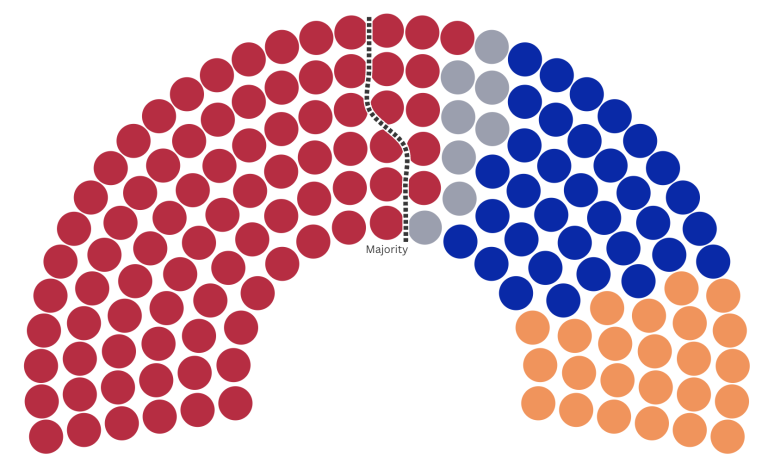
DemosAU’s seat estimate, which applies a uniform swing to the May-June 2026 MRP model, shows Labor would win a majority in parliament if the results were replicated at an election.
Voters still back Anthony Albanese as preferred prime minister (36%) compared to Pauline Hanson on 25% and Angus Taylor on 21%.
In a two-way preferred PM contest between Ms Hanson and Mr Albanese, Albanese led 45-33% (+2 for Albanese and +1 for Hanson since August).
Prime Minister Anthony Albanese had the weakest net positive score of -16% (a three percent improvement since August) followed by Ms Hanson on -12% (a four percent improvement). Mr Taylor was -4% (no change).
Cost of living and inflation remains the number one concern facing Australia according to 42% of voters.
The poll also showed strong support for the federal government’s proposed social media duty of care legislation, including its plan to require social media companies to allow users the choice to opt out of receiving algorithmically recommended content in their feed.
Two thirds of voters (66%) backed the opt-out requirement, with only 13% opposed.
A similar number (65%) also said social media companies should be legally required to reduce foreseeable risks to users, even if this means placing more restrictions on how their platforms operate. In contrast, 22% believed platforms should generally be free to decide how their platforms operate, even if this means users may face greater risks of harm.
DemosAU Head of Research George Hasanakos said Labor’s vote had improved but only narrowly.
“This is the best result for Labor according to our polling since February this year,” Mr Hasanakos said.
“Labor is still leading One Nation on the primary vote, albeit by only two percentage points, so it’s still a very close race.”
“Given the fluidity of recent polling results, the nature of the single member electoral system and the fracturing of the former two party system, the contest between Labor, One Nation and the Coalition is wide open.
Mr Hasankos said the improvement in Labor’s primary has been driven by an increase in support from voters under 35.
“It’s not entirely clear what may have driven that improvement in support, it could be the government’s recent focus on social media regulation and AI, federal politics moving on from the post-budget debate, or the fact Mr Albanese and his colleagues have recently stepped up their criticisms of Pauline Hanson and One Nation.”
Mr Hasanakos said if these poll numbers were reflected at an election, Labor would win between 76 and 88 seats, while One Nation would win between 38 and 49 seats. The Coalition would win between 8 and 21 (Liberals between 8 and 17 and The Nationals between 0 and 4), The Greens between 0 and 4 and Others between 6 and 11.
The DemosAU seat projection is based on a Monte Carlo probability analysis of 20,000 simulations.
“On these figures Labor would win a majority, either a slim majority or a convincing majority, while One Nation would be the official Opposition.”
“Our last poll showed a knife edge hung parliament with Labor winning significantly fewer seats, so a two percent primary vote increase has definitely helped put Labor in a stronger position,” he added.
About the poll
The margin of error is +/- 3.3%